
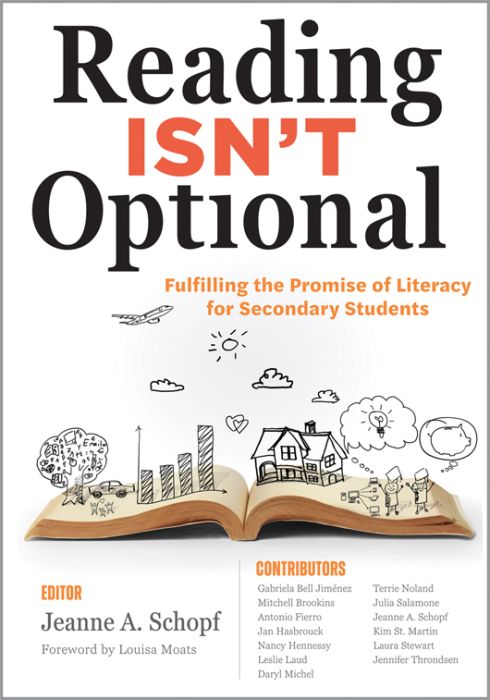
 I find that summer is the perfect time to catch up on my professional reading. This summer I participated in The Reading League's Chapter Network Book Study for Reading Isn't Optional: Fulfilling the Promise of Literacy for Secondary Students, a collection of insights on adolescent literacy for educators working with students in grades 4–12. Too often, it is assumed that older students who struggle with reading will never learn how to read—an incorrect and harmful assumption. This book offers guidance from multiple authors on how secondary schools can challenge the misconception that it is too late for struggling readers and provide the instruction they need to succeed.
My biggest takeaway after reading this book was that older students can be taught to read and write at the level they need to succeed in life. Of course, I had many other takeaways—too many to share in one blog post—but I want to highlight the things that stood out to me most. I encourage you to read the book to explore the ideas highlighted below more deeply.
3 Myths that Hinder Adolescent Literacy
Misconceptions about how students learn to read can be particularly damaging, as they hinder adolescent readers' success. There are three pervasive myths related to adolescent literacy:
Myth #1: Good Readers Rely Heavily on Context Clues
Fact: Fluent reading depends on the brain's ability to decode words efficiently rather than relying on context clues. Skilled readers process each letter and word systematically, and decoding instruction must be prioritized for those who need it.
Myth #2: If students haven't learned to read before reaching secondary school, it's too late.
Fact: If a student has an underlying decoding deficit, they will not be able to read and understand the complex informational and narrative texts that they encounter in the upper grades—and most importantly, this decoding deficit can be corrected at the secondary level.
Myth #3: Students Who Are Taught to Their Preferred Learning Style Will Learn Better.
Fact: Learning styles are a myth—there is no credible evidence that they exist. Students need to be explicitly taught a defined set of skills using evidence-based, research-backed curriculum regardless of their perceived learning style.
Implementing the Science of Reading with Adolescent Learners
The majority of secondary teachers, except most special education teachers, are not trained in teaching reading. Therefore, schools need to empower their teachers by helping them build a base of knowledge about reading and learning through the science of reading, the science of learning and teaching, and the science of implementation.
The school culture should reflect the belief that it is everyone's responsibility to teach reading. Strong leadership, Multi-Tiered Systems of Support (MTSS), and student-focused coaching are all necessary for effective literacy instruction for adolescent readers. By combining these important components, schools create a strong foundation that supports literacy for all their students.
Research on literacy identifies effective practices to implement in secondary schools in the following areas of literacy:
-
Fluency
Fluency—reading with accuracy and expression at an appropriate rate—is essential for comprehension. Assessing a student's fluency and scoring accuracy, rate, and expression is the first step in identifying students in need of support. Support can take many forms in the secondary classroom, and for those who struggle the most, individualized intervention is necessary.
-
Comprehension
Comprehension difficulties rarely exist in isolation; decoding or fluency difficulties often accompany them, and some students can read the words but struggle to construct meaning. Teaching students to notice when meaning breaks down and use strategies to repair understanding strengthens their comprehension. Engaging in discussions to make meaning, using text structure to support their understanding, drawing inferences that combine background knowledge with text evidence, and writing responses, summaries, and syntheses all support their ability to comprehend successfully.
-
Vocabulary
Vocabulary instruction is essential for students to become proficient with the complex text they encounter in secondary school. Practices that support vocabulary acquisition include rich, varied language experiences through read-alouds, wide reading, purposeful writing, directly teaching individual words that are key to understanding the text, teaching word-learning strategies such as morphological analysis, context clues, and effective dictionary work, guiding students as they apply the strategies, and promoting word consciousness.
-
Scaffolding Grade and Course Level Text
Instructional scaffolding does not mean changing the content students are working with; rather, it means changing the support. To build knowledge and skills, accelerate reading growth, expand content knowledge, develop vocabulary, and enhance students' ability to negotiate increasingly complex topics, all learners need exposure to grade- and course-level texts*. Scaffolding strategies that have been shown to work include providing students with a purpose for reading, explaining the skills and knowledge they will learn, activating or building background knowledge, engaging students in active reading, summarizing main ideas and key details, participating in collaborative discussions, and reflecting on or revisiting the text.
*At the same time, older students who struggle with reading should also receive instruction at an intervention level to address foundational skill gaps — both experiences are necessary and neither should replace the other.
-
Writing Instruction
Writing is a critical skill for college and career success because it strengthens communication, content knowledge, and critical thinking. Because students do not learn to write naturally, writing should be explicitly taught through a gradual release model with ongoing formative feedback.
-
Oral Language: Speaking and Listening
Reading and comprehension depend on many factors, including a student's receptive (listening and reading) and expressive (speaking and writing) skills. Prioritizing rich classroom discussion helps students comprehend complex texts and produce high-quality writing.
-
Foundational Skills for English Learner Newcomers
For English learners, literacy should be explicitly and systematically taught within a structured literacy model. Adolescent English learner newcomers especially benefit from explicit foundational skills instruction early in their schooling in the U.S., alongside age-appropriate content instruction with peers, with support continuing as needed to accelerate literacy development.
Read Naturally Programs that Support Adolescent Literacy
Read Naturally solutions that put this literacy research into practice include:
-
Read Naturally Live (fluency, phonics)
-
Read Naturally Live—Español (fluency)
-
Word Warmups Live (phonics)
-
One Minute Reader Live (independent reading, fluency)
-
Encore II (fluency, phonics)
-
Comprehension Builder (comprehension)
-
Word Warmups Print (phonics)
-
Signs for Sounds (spelling, phonics)
-
Read Naturally GATE+ (phonics, fluency)
-
Take Aim at Vocabulary (vocabulary)
If you work with students at the secondary level, I highly recommend that you pick up a copy of Reading Isn’t Optional: Fulfilling the Promise of Literacy for Secondary Students and do the work necessary to support your learners who struggle to read.
Schopf, J. A. (Ed.). (2026). Reading isn’t optional: Fulfilling the promise of literacy for secondary students. Solution Tree Press.
 Share your student’s success story—nominate him or her for our Star of the Month award. Win a Barnes & Noble gift card for the student and a Read Naturally gift certificate for your class!

Post a New Comment